
Arrest Records in Rockland County
An arrest record is the file created when police take a person into custody. In Rockland County, town and village police, the State Police, and the Rockland County Sheriff all make arrests. After an arrest, the person is often booked at the Rockland County Correctional Center. The Sheriff's Office runs that jail. Booking captures the basics: name, the charge, the arresting agency, and the date. From there, the person may post bail, see a judge, or stay in custody. The arrest record sits with the arresting agency and the jail, not with the courts.
Arrest records are not the same as criminal court records, and neither one equals a conviction. An arrest means police had probable cause. A court record begins once charges are formally filed and the case lands in front of a judge. A conviction is the final outcome after a plea or trial. Each lives in a different place. Arrest and booking data come from the Sheriff and police. Full case history sits with the courts and is covered on the Rockland County court records page. The sections below lead with arrest and jail intake first.
How to Search Rockland County Arrest Records
There is no single web roster on the Sheriff's site that lists every recent arrest. The official path for custody and arrest information runs through the Rockland County Sheriff's Office app and the jail information phone line at 845-638-5600. For charges that have reached a court, the state's WebCriminal system shows public criminal case data. The mix of tools depends on how far the case has moved. A fresh arrest may only show up by phone or app; a charged case shows up in the court system.
- For a recent arrest or someone you think is in jail, call the Rockland County Correctional Center information line at 845-638-5600 or use the Sheriff's mobile app.
- To check whether charges have been filed in court, run a name search on the state WebCriminal Defendant Search and select Rockland County Court or Rockland County Supreme Court.
- For full case files, motions, and dispositions, use the court records tools and the County Clerk eSearch portal.
- If the person was sent to state prison, look them up through the NYS DOCCS incarcerated individual locator instead of the county jail line.
The WebCriminal defendant screen is the most direct public window into Rockland criminal cases. You can search by name or by case number across the county courts. The official page warns of update delays for some cases, so a search that comes up empty may need a second try later.
The defendant search page is the place to start once a charge reaches the court. The screen below shows the name fields and court filter.
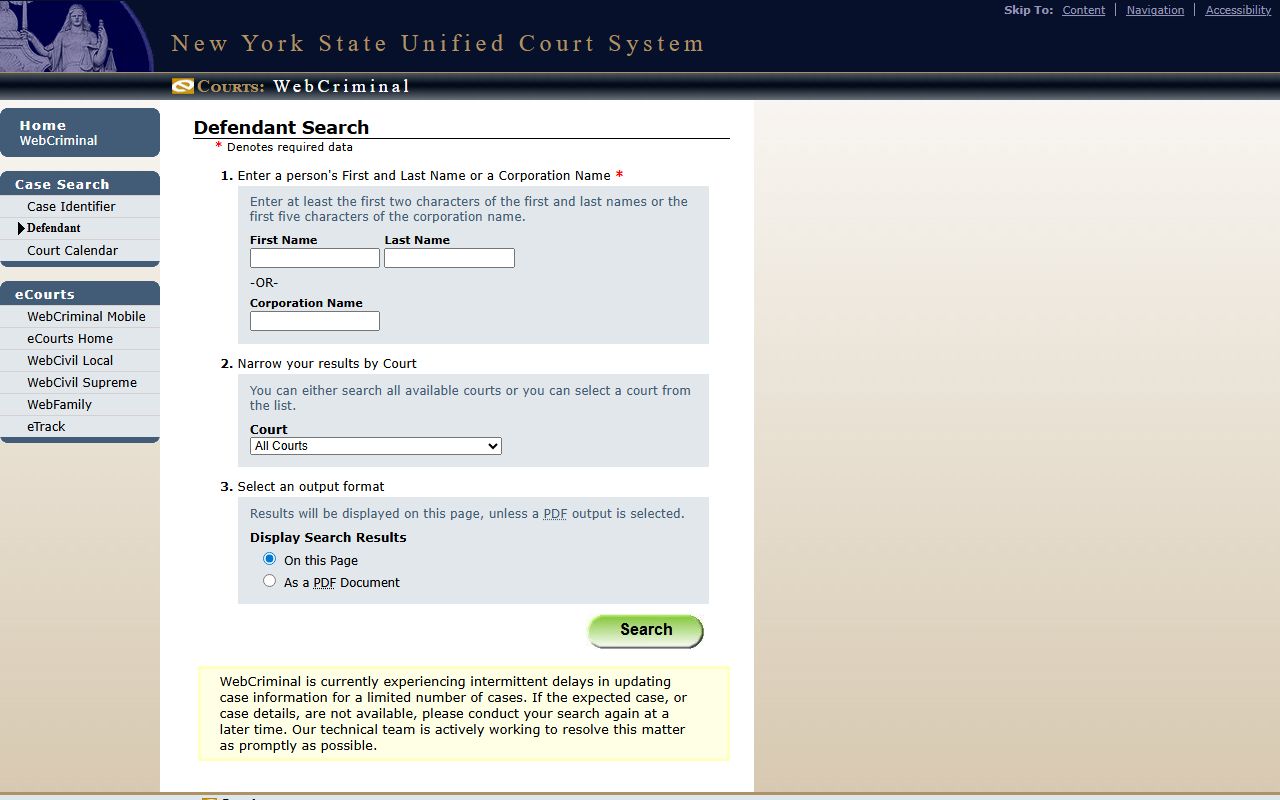
From that screen, enter at least the first two letters of the first and last name, pick the court, and choose how to display results. The same system also offers a case number lookup, which the warrant records page covers in more detail.
WebCriminal Defendant Search Fields
The WebCriminal Defendant Search uses a short set of fields. You can search by an individual name or by a corporation name, but not both at once. The court filter lets you limit results to Rockland County Court and Rockland County Supreme Court, or search all courts statewide. Output can show on the page or as a PDF. The table below lists each field and how it works.
| Field Label | Type | Required | Notes |
|---|---|---|---|
| First Name | Text | Conditional | First and last name together; enter at least the first two characters of each. |
| Last Name | Text | Conditional | Same rule as the first name field. |
| Corporation Name | Text | Conditional | Use instead of a personal name; enter the first five characters. |
| Court | Dropdown | No | All Courts or a single court; includes Rockland County Court and Rockland County Supreme Court. |
| Output format | Radio | No | Show results on the page or as a PDF document. |
Note: WebCriminal reports occasional delays in updating case data, so a missing case may simply need a repeat search later.
Arrest Records vs. Criminal Court Records
An arrest record and a criminal court record describe two different stages. The arrest record is born at the jail or police desk during booking. It captures who was taken in, by whom, and on what charge. The court record begins later, once a prosecutor files charges and the case opens in front of a judge. One is a snapshot of custody. The other tracks the legal fight that follows. Many people confuse the two, but they come from separate offices and serve separate purposes.
| Arrest Record | Criminal Court Record | |
|---|---|---|
| Source | Police / Rockland County Sheriff | County Court / Supreme Court via WebCriminal |
| Created When | Booking and jail intake | Charges filed in court |
| Contents | Name, charge, arresting agency, booking date | Indictments, motions, pleas, disposition |
| Where to Look | Sheriff app / jail line 845-638-5600 | WebCriminal and the court clerk |
If you only need to know whether someone is in custody, the jail line and app answer that fast. If you need the case outcome, the court tools carry that. Full pleadings and dispositions are explained on the court records page.
Charges vs. Convictions
A charge is not proof of guilt. When police arrest someone, they need only probable cause, a fairly low bar. A conviction is far harder to reach. It requires a guilty plea or a verdict reached beyond a reasonable doubt. Many arrests never end in a conviction. Cases get dismissed, reduced, or resolved through diversion programs. Reading an arrest record as a guilty verdict is a common and serious mistake.
| Charge | Conviction | |
|---|---|---|
| Stage | Accusation at or after arrest | Verdict or guilty plea |
| Burden of Proof | Probable cause | Beyond a reasonable doubt |
| Final? | No, the case is still open | Yes, the case is decided |
| Possible Outcome | Dismissal, reduction, diversion | Sentence or disposition entered |
The Rockland County District Attorney runs several diversion tracks, such as Drug Court and a Veteran's Alternative to Incarceration program. People who finish those programs may avoid a conviction even after an arrest. So a charge on an arrest record can end many different ways.
Sealed vs. Expunged Records
New York does not erase criminal records the way some states do. There is no broad expungement that destroys the file. Instead, New York uses sealing. A sealed record still exists, but it is hidden from most public view, with limited access kept for certain agencies and law enforcement. The word "expungement" gets used loosely, yet in practice the New York remedy is almost always sealing.
| Sealed (New York) | Expunged | |
|---|---|---|
| Visibility | Hidden from public view | Destroyed or treated as never existing |
| Law Enforcement | Limited access kept by statute | Very limited or none |
| Used in New York? | Yes, the standard remedy | Rare; not the general adult remedy |
Several statutes drive New York sealing. Under Criminal Procedure Law § 160.50, records are sealed when a case ends in the accused person's favor, such as a dismissal or acquittal. Under CPL 160.55, certain noncriminal and traffic infraction outcomes get limited sealing, though qualified agencies may keep access. Under CPL 160.59, a person with no more than two convictions, only one of them a felony, may apply to seal old convictions after at least ten crime-free years. The application goes to the sentencing court, the District Attorney gets notice and can object, and the filing fee is $5 outside New York City. Sex offenses, violent felonies, and serious felonies are not eligible. You can read the official criminal records sealing guidance for the full rules.
The screen below comes from the NY Courts help section on sealing. It explains which cases qualify and how the process runs.
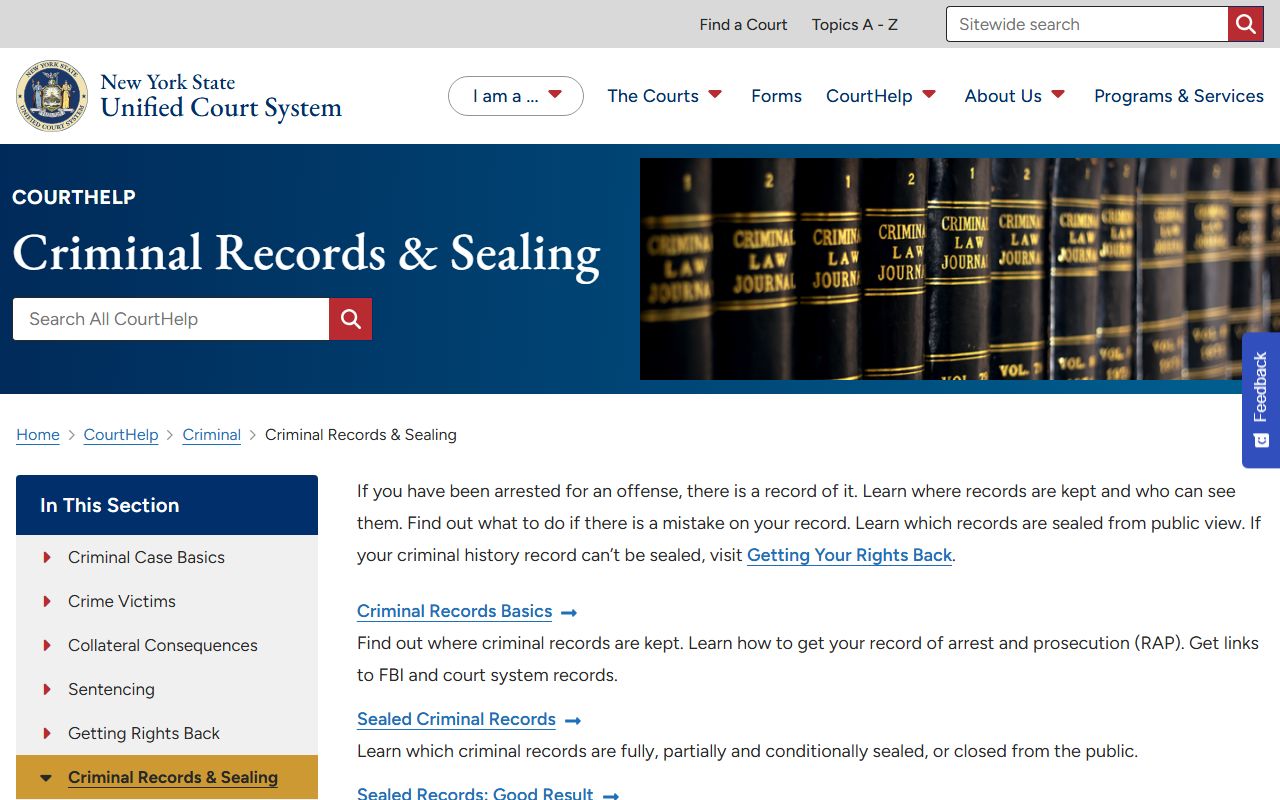
The same help center also covers the ten-year conviction sealing path under CPL 160.59 in its own dedicated page. Even after sealing, immigration authorities and some background checks may still see the record.
Mugshots and Booking Photos
A mugshot is the photo taken during booking. In Rockland County, the Sheriff's Office handles intake at the Correctional Center, and any booking photo lives in that custody file. The official Sheriff website does not post a public web roster with photos. Instead, it directs people to the Sheriff's mobile app and the jail information line at 845-638-5600. Because no public mugshot gallery is published on the official site, booking photos are not freely browsable online through county channels.
Be careful with third-party mugshot sites. Many pull old data and never update it. A photo posted there may tie to a charge that was later dropped or sealed. For accurate custody status, the Sheriff's app and the jail phone line are the reliable sources.
The District Attorney and Public Defender
Two offices shape what happens after a Rockland arrest. The District Attorney prosecutes the case. The Public Defender represents people who cannot afford a lawyer. Both sit at the New City courthouse campus and both are central to how an arrest record turns into a court outcome.
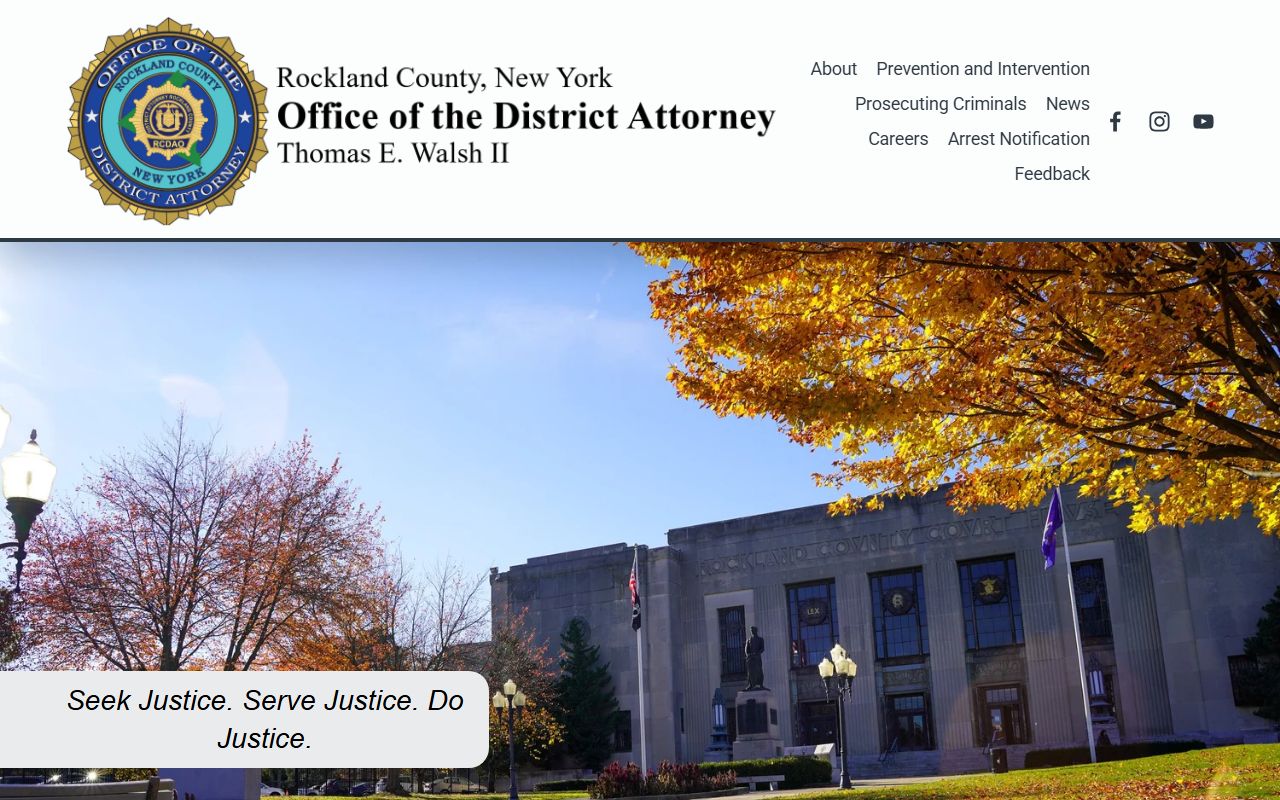
The Rockland County District Attorney is Thomas E. Walsh II. The office investigates and prosecutes crimes across the county, and it runs prevention and diversion units, including a Drug Task Force, a Special Victims Unit, and several alternative-to-incarceration programs. The DA's official homepage lists current news and contact details.
The image below shows the District Attorney's homepage, where the office posts updates and lists its address and phone.
On the defense side, the Rockland County Public Defender represents people accused of offenses and crimes in local Justice Courts and County Court. The office also handles appeals, parole and probation violation hearings, and extradition proceedings. To apply, you complete an intake form, upload your charges or tickets, and sit for a financial eligibility interview. There is no appointment; interviews run first come, first served. File processing takes 48 hours, so apply early and do not wait until the day before court.
The Public Defender page is where applications begin. The screen below shows the intake landing page.

You can start the process from the official Public Defender page. Bring a copy of your charges, since interviews cannot be done without them.
Statewide and Federal Criminal Records
Some Rockland arrests move beyond the county level. State prosecutions and statewide criminal history searches reach further than the county jail or court tools. New York criminal cases in the county courts are searchable through WebCriminal, but a full statewide rap sheet from the Division of Criminal Justice Services is restricted and not a public web search. Most public searches stay at the case level.
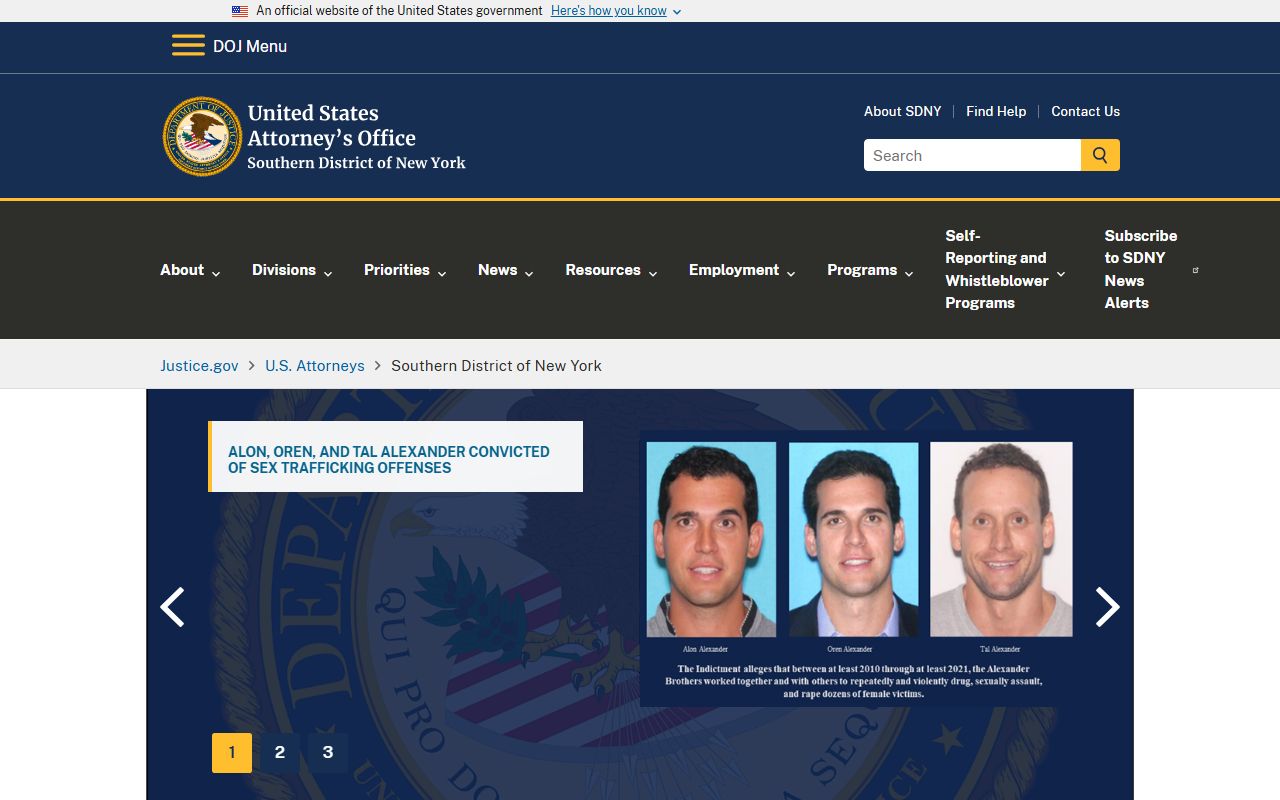
Federal arrests are different again. A federal case in this area is prosecuted by the U.S. Attorney's Office for the Southern District of New York, which covers Rockland County. Federal court files live in PACER, not the county system. The U.S. Attorney's Office for SDNY handles federal prosecutions in the region.
The screen below shows the U.S. Attorney's Office for the Southern District of New York, the federal prosecutor for Rockland County matters.
For someone in federal custody after a conviction, the Bureau of Prisons inmate locator is the right tool, not the county jail line. Federal and state records simply do not flow through Rockland County offices.
Background Check Considerations
There is a real difference between a casual records lookup and a regulated background check. A formal background check used for hiring, housing, credit, or insurance must follow the Fair Credit Reporting Act. Those reports come from licensed consumer reporting agencies that follow strict accuracy and dispute rules. A free public search of arrest or court records does not meet that standard and should not be used for those decisions.
Arrest records also age poorly. A charge may have been dropped, reduced, or sealed long after the arrest. Relying on a raw arrest entry can lead to wrong conclusions about a person.
Important: A Rockland County arrest record is not a background check. Arrest data may not be used for employment, tenant, credit, or insurance screening under the FCRA.
Restricted Criminal Records in Rockland County
Not every arrest or criminal record is open to the public. New York shields several categories by statute. Youthful offender adjudications are sealed and excluded from public viewing. Juvenile delinquency matters handled in Family Court are restricted. Mental hygiene records tied to court proceedings are confidential. Cases that ended in the accused person's favor are sealed under CPL 160.50. The County Clerk also expressly excludes mental hygiene, matrimonial, and youthful offender files from public review.
Active investigations add another layer. Sealed search warrants and ongoing matters may not appear in any public search. Grand jury material is generally secret. So a blank search result does not always mean nothing exists. For warrants tied to a public case, see the Rockland County warrant records page. To look up someone currently held, use inmate records.
Note: A clean public search does not guarantee a person has no record, since sealed and confidential files do not show up in open databases.