
New York Freedom of Information Law
Access to government records in New York runs through the Freedom of Information Law, known as FOIL. It lives in Public Officers Law Article 6, sections 84 through 90. FOIL sets a state policy that government records are open to the public, with limited exceptions. It applies to administrative records held by state and local agencies, including the administrative records of the court system. It does not work the same way for individual court case files, which follow court rules instead, and it does not reach records generated by local police in the same manner. The official NY Courts FOIL page explains that split clearly.
Anyone can file a FOIL request. You do not have to be a New York resident, and you usually do not have to say why you want the records. The core access section is Public Officers Law section 87, which both grants access and lists the categories an agency may withhold. The Committee on Open Government oversees FOIL statewide and issues advisory opinions on how it should work. For Rockland agency records, the county FOIL process is the route, not the court case portals.
The official text of the law is published by the Committee on Open Government, and the NY Courts FOIL page describes how it applies to court system administrative records. The image below shows that court FOIL page. The full statute is available as a Public Officers Law Article 6 PDF from the Committee on Open Government.
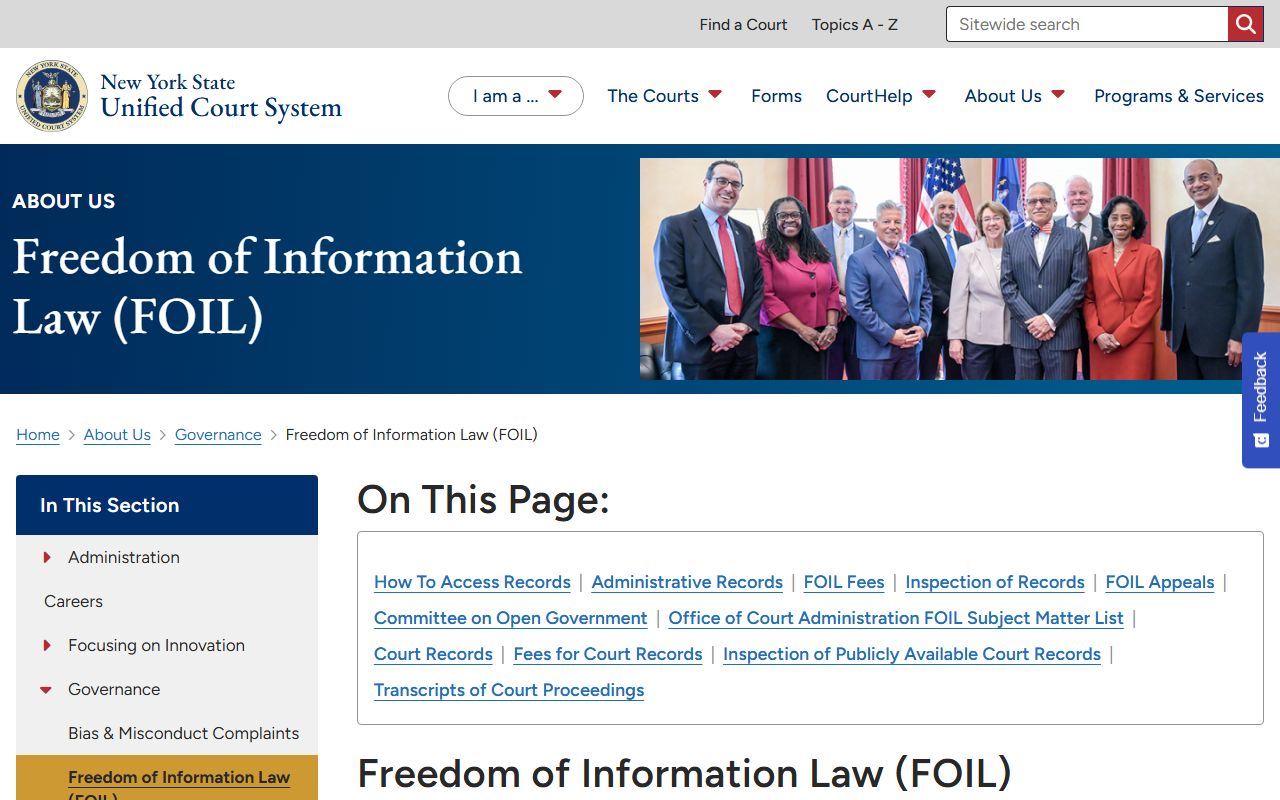
That page is a good starting point for understanding what FOIL covers before you send a request to a county office.
What Records the County Clerk Maintains
The Rockland County Clerk keeps a large body of public records that have nothing to do with criminal or civil court cases. The office handles land records, business certificates, naturalization records, notary filings, tax warrants, maps, and judgments. Many of these can be searched and viewed free of charge online, and some records reach back to 1798. The Clerk's document management system is open 24 hours a day for searching.
- Land records, including deeds and mortgages.
- Business certificates and assumed-name filings.
- Naturalization records.
- Notary public filings.
- Tax warrants and judgments.
- Maps and survey records.
These are distinct from court case files. The same office files and records documents for the Supreme and County Courts, but the land and business records above are the non-court public records most people come looking for. Section, Block, and Lot references in the system are not verified by the Clerk and can be wrong, so confirm them with the town or village assessor.
The County Clerk also registers domestic partnerships and processes name change and uncontested divorce packets, and the office runs passport and pistol license services. Older files have a home of their own. Court files commenced more than about six years ago move to the county Archives building on Sanatorium Road in Pomona, while newer files stay at the courthouse. To pull a physical file at either spot, a visitor fills out a File Request Card. Files can be viewed only at those locations and cannot leave the building.
How to File a Public Records Request in Rockland County
A FOIL request goes to the agency that holds the records you want. For county department files, that means the relevant Rockland County office and its records access officer. For land and business records, the County Clerk's online system often answers the need without a formal request. A good request names the records as clearly as you can.
- Identify which office holds the records. County department files go to that department; land and business records sit with the County Clerk.
- Describe the records as specifically as possible, with names, dates, or a date range to help staff find them.
- Submit the request to the agency's records access officer by mail, email, or any online portal the office offers.
- Wait for the agency response. FOIL requires the agency to acknowledge the request and either grant it, deny it, or give a date when it will respond.
- Pay any allowed copying fee, then receive the records or a written explanation of any withholding.
Public Records Request Form Fields
A FOIL request does not have to use a special form, but most agencies offer one and it speeds things up. The fields below cover what a typical request includes. The more detail you give in the description, the faster the agency can locate the records.
| Field | Required | Notes |
|---|---|---|
| Requester Name | Yes | So the agency can respond to you. |
| Contact Information | Yes | Mailing address or email for the response. |
| Description of Records | Yes | Be specific; name documents, parties, or subject. |
| Date Range | No | Helps narrow the search and reduce fees. |
| Format Preference | No | Paper copies or electronic, if available. |
FOIL Response Timelines
FOIL sets a basic clock. Under Public Officers Law section 89, an agency must respond to a request within a set time, usually by acknowledging it within five business days and then granting or denying access or giving a reasonable date for its answer. Large or complex requests can take longer, but the agency must explain the delay. If the agency stays silent or misses its own stated date, that can be treated as a denial, which opens the door to an appeal. Section 89 is the part of FOIL that lays out procedure, response time, and the appeal path.
Public Records Fees in Rockland County
FOIL fees generally cover copying or the actual cost the law allows, not the staff time to think about a request. The County Clerk's posted court-record copy charges give a useful local picture of what document copies cost in the county. Certified copies cost more because they carry an official seal.
| Item | Amount |
|---|---|
| Hard-copy document copy (County Clerk) | $0.50 per copy |
| Certified copy (County Clerk) | $1.25 per page, $5 minimum |
| Online document print (eSearch) | $0.50 per page |
| Online viewing (guest sign-in) | Free |
Note: FOIL allows agencies to charge for copies and certain costs, but online guest viewing of County Clerk records is free.
Records That Are Confidential
Not every record is open. Public Officers Law section 87 lets an agency withhold material in defined categories. Those include records whose release would be an unwarranted invasion of personal privacy, records that would interfere with a law enforcement investigation or a judicial proceeding, confidential source information, trade secrets, and records made exempt by another statute. Court records add their own confidential categories on top of FOIL.
In Rockland, the County Clerk does not let the public view mental hygiene, matrimonial, or youthful offender files. Sealed criminal records are also closed. New York seals certain convictions after ten years under Criminal Procedure Law section 160.59, with a $5 filing fee outside New York City. Other sealing statutes cover favorable case terminations and juvenile matters. Personal identifiers, such as Social Security numbers and account numbers, are redacted under privacy rules.
The criminal sealing rules are explained on the NY Courts CPL 160.59 sealing page, shown below. Sealing limits what shows up in a public record search even when an underlying case once existed.
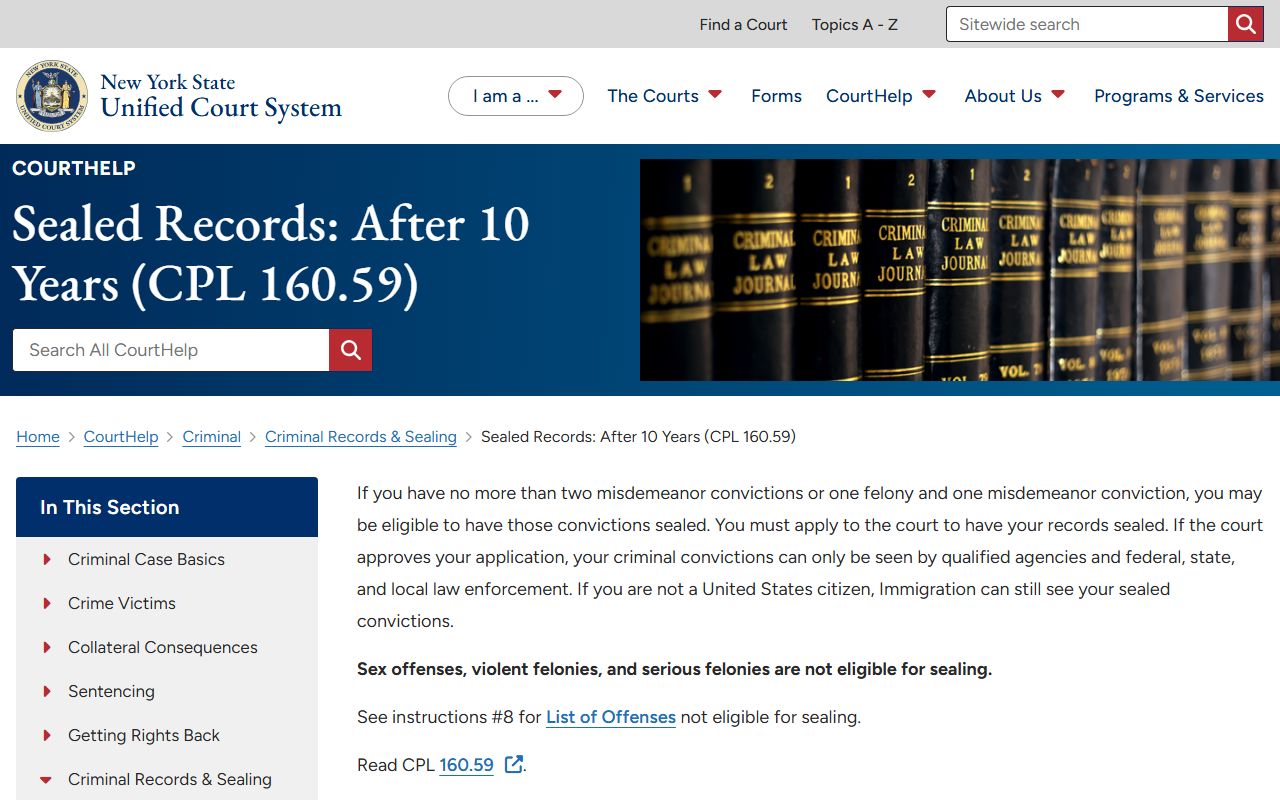
Because sealing keeps records off public searches, an old case may not appear at all, which is by design under the statute.
If Your FOIL Request Is Denied
A denial is not the end. FOIL builds in an appeal. When an agency denies access, it must tell you how to appeal, and that appeal goes to the agency's designated FOIL appeal officer. The appeal is filed in writing within the time the agency states. If the appeal also fails, a requester can seek court review under Article 78 of the Civil Practice Law and Rules. The Committee on Open Government can also give advisory guidance, though it does not decide cases. Federal records, such as bankruptcy filings, follow a separate federal system rather than FOIL.
Federal court records for the region run through the Southern District of New York, which covers Rockland County, and bankruptcy matters go to its bankruptcy court. The SDNY Bankruptcy Court site handles those filings, shown below. FOIL does not apply to federal records, so use the federal PACER system for them instead.
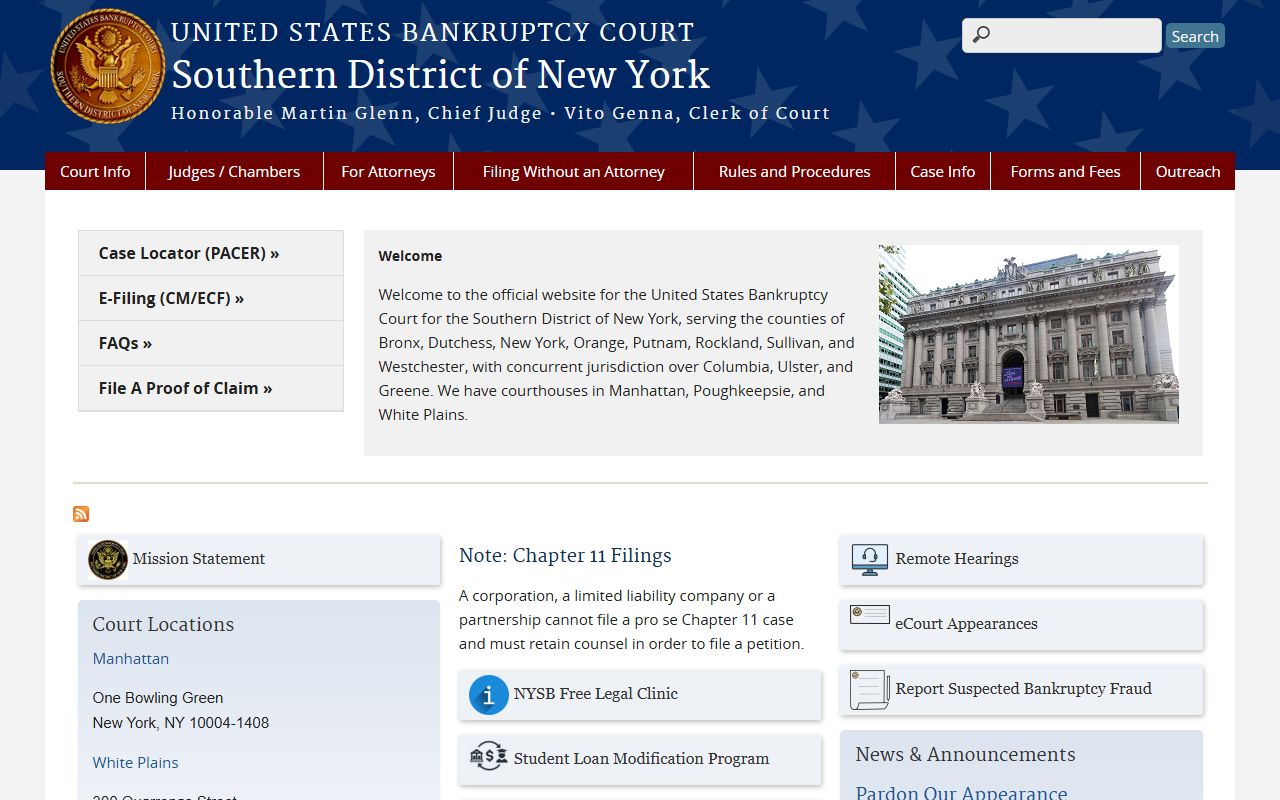
Keeping the state and federal tracks separate avoids sending a request to the wrong place.