
What Surrogate's Court Covers in Rockland County
The Rockland Surrogate's Court handles the legal side of death and inheritance. It probates wills, meaning it confirms that a will is valid and admits it to record. When there is no will, the court administers the estate instead. It appoints the fiduciary who settles the estate, reviews accountings, and issues the decrees that close a case. The court also handles guardianship of a minor's property and certain trust and estate proceedings. Some adoption-related matters fall here too, subject to strict confidentiality.
Venue is specific. Estate matters for the county go to the Rockland Surrogate's Court, not a generic probate court. New York uses the title "Surrogate's Court," and the judge who presides is called the Surrogate. The court sits in the county courthouse in New City and shares the building with the County Clerk and other county courts. Estate files are kept by the Surrogate's Court itself, separate from the criminal and civil case systems.
The court's reach is wider than just wills. It oversees estate accountings, decrees that resolve disputes among heirs, and proceedings tied to a minor's property. It also takes on trust matters that connect to an estate. Because so much of what the court does affects who inherits, the records draw interest from heirs, attorneys, creditors, and family historians alike. The Chief Clerk runs the office day to day, and staff can point filers to the right form for each type of case.
Surrogate's Court Terms Defined
Estate filings use words that rarely come up in daily life. A quick guide helps before you read a file or fill out a petition. These terms appear across most Rockland County Surrogate's Court records.
- Testator
- The person who made the will. After death, that person's will is offered for probate.
- Executor
- The person named in a will to carry out its terms. The court confirms the executor through probate.
- Intestate / Administration
- Dying without a valid will is dying intestate. The estate then goes through administration, where the court appoints an administrator to settle it under state law.
- Letters testamentary
- The court order that gives an executor legal power to act for the estate. Banks and others ask to see these letters.
- Fiduciary
- Any person trusted to manage the estate, such as an executor or administrator. A fiduciary must act in the estate's best interest.
- Guardianship
- A court arrangement where someone is given authority over a minor's property or interests in an estate matter.
Probate vs Administration
The path an estate takes depends on one question. Was there a valid will? If yes, the estate goes through probate. The named executor petitions the Surrogate's Court, the court reviews the will, and if all is in order it admits the will and issues letters testamentary. The executor then follows the wishes set out in the will.
If there is no will, the estate goes through administration. A close relative usually petitions to serve as administrator. The court appoints that person and issues letters of administration. Because there is no will to follow, state intestacy law decides who inherits and in what shares. Probate honors the deceased person's written plan. Administration applies a default plan set by law. Both routes run through the same Rockland Surrogate's Court and both end with the fiduciary distributing what remains after debts and taxes.
How to Search Rockland County Surrogate's Court Records
Estate filings can be searched online through WebSurrogate, the state tool linked from the Rockland Surrogate's Court page. A file-number search needs the exact file number on record. If you do not have the file number, a name search may help, though the live label should be checked on the screen. When nothing turns up online, the court itself can confirm whether a file exists.
- Open WebSurrogate from the official Rockland Surrogate's Court page and select Rockland Surrogate's Court as the court and county.
- Enter the file number if you have it, since the file-number search must match the number on record exactly. Otherwise use the name field.
- Run the search, review the results, and contact or visit the Surrogate's Court if no online file is found.
The official WebSurrogate search tool is linked from the court page, and the screen below shows the public lookup. You can open WebSurrogate to start an estate search by court and file number. The image gives a preview of the layout before you log in.
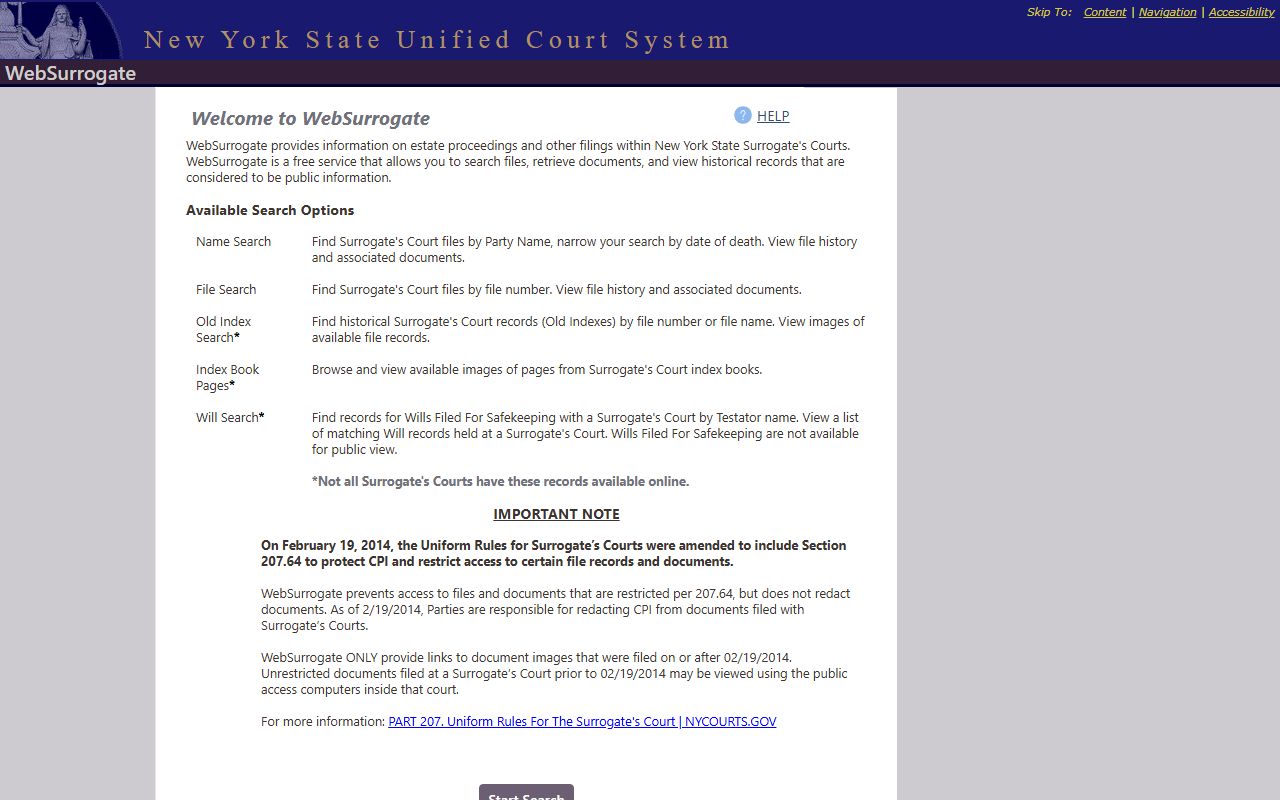
That tool is the fastest way to confirm whether an estate has been filed before you make a trip to the courthouse.
WebSurrogate Search Fields
The WebSurrogate screen uses a small set of fields. Knowing them ahead of time speeds up the lookup. The table maps each control from the official search tool.
| Field | Type | Required | Options / Format Notes |
|---|---|---|---|
| Court / County | Dropdown | Yes | Select Rockland Surrogate's Court / Rockland County. |
| File # | Text | Primary | Must exactly match the file number on record. |
| Decedent / name search | Text | Optional | Used to look up an estate proceeding by name; verify the live label on screen. |
| Search | Button | Yes | Runs the search. |
| Clear / Reset | Button | Optional | Resets the form; confirm the live label on screen. |
Rockland County Surrogate's Court
The county has one Surrogate's Court, located in the courthouse in New City. The Surrogate is Hon. Keith J. Cornell, and the Chief Clerk is Heather Barney, Esq. The office links forms, fees, e-filing, and WebSurrogate from its official court page.
Rockland County Surrogate's Court
1 South Main Street
New City, NY 10956
845-483-8270
Mon-Fri 9:00 a.m. to 5:00 p.m. (closed state holidays)
The Rockland Probate Process
An estate moves through the Surrogate's Court in a set order. The steps below trace a typical case from the first filing to final distribution. Exact paperwork varies with the size of the estate and whether anyone contests the will.
- Determine whether there is a will.
- File a probate petition if there is a will, or an administration petition if there is none.
- Submit the death certificate, the original will if any, heir and family information, waivers or citation requests, and the required court forms.
- Pay the Surrogate's Court filing fees set on the official fee schedule.
- The court reviews jurisdiction, interested parties, and required notices.
- The Surrogate issues letters testamentary or letters of administration if the petition is approved.
- The fiduciary gathers assets, notifies creditors, pays valid claims and taxes, and distributes what remains.
- Accounting or closing papers may be required depending on the estate and the court's direction.
Surrogate's Court Filing Fees
Surrogate's Court charges filing fees based on the type of petition and, for estates, often the size of the estate. The exact dollar amounts were not captured in the research and are not listed here to avoid a wrong figure. New York sets these fees on the official NY Courts filing-fee schedule, and the Rockland Surrogate's Court page links to it. Check that schedule, or call the court at 845-483-8270, before you mail a filing so the payment matches the current amount.
Note: do not rely on a guessed fee for a Surrogate's Court filing, since an incorrect payment can delay the petition.
What Rockland County Surrogate's Court Records Show
An estate file builds up as a case moves along. Early on it holds the petition, the death certificate, and the will if one exists. As the case proceeds, the file can show waivers and consents, citations to interested parties, the letters issued to the fiduciary, asset inventories, accountings, and the final decree. These records let heirs, creditors, and researchers trace how an estate was handled and who received what. Many of these documents are public, which is why genealogists and title searchers often pull old estate files.
Restricted Surrogate's Court Records
Not every estate record is open. Adoption matters and sealed files are confidential, and access usually needs a statutory basis or a court order. Sensitive personal identifiers, such as account numbers, are redacted or withheld under privacy rules. Original wills and active estate files should be handled through the court, not pulled from unofficial genealogy aggregators that may post outdated or incomplete versions. When in doubt about whether a file is open, ask the Surrogate's Court directly.